What does (S) mean in NASA
In fast-paced administrative, technical, and project management environments, shorthand symbols and abbreviations are essential tools for streamlining communication. If you have ever encountered this specific notation on a workflow chart or a compliance checklist, you might naturally wonder: what does (S) stand for in these contexts? In the specialized framework of task classification and risk assessment, the (S) full form translates directly to "Safe."
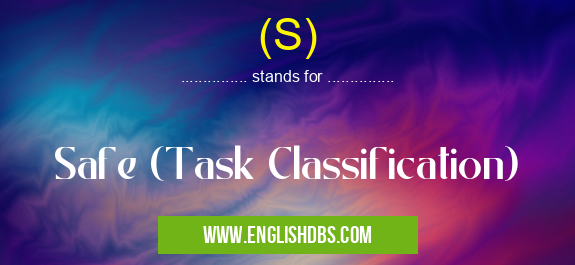
(S) meaning in NASA in Governmental
(S) mostly used in an acronym NASA in Category Governmental that means Safe (Task Classification)
Shorthand: (S),
Full Form: Safe (Task Classification)
For more information of "Safe (Task Classification)", see the section below.
» Governmental » NASA
Understanding the (S) meaning is highly beneficial for project managers, safety officers, and team members alike. It serves as a visual indicator that a specific task, operational step, or data-handling procedure carries minimal risk and can be executed without extraordinary security measures or hazardous duty protocols. By establishing a clear classification system, organizations can optimize their daily operations while maintaining a strong commitment to safety and compliance.
(S) Meaning in GOVERNMENTAL
In public administration, civil service, and municipal operations, clear task labeling is vital for maintaining organizational order and protecting workers. When analyzing the (S) meaning in GOVERNMENTAL departments, the "Safe" task classification plays a critical role in workflow distribution, safety auditing, and resource allocation.
Government agencies deal with a vast spectrum of tasks, ranging from high-risk field operations to standard administrative duties. To manage these effectively, tasks are classified based on their inherent risk levels. Here is how the (S) classification is utilized within governmental frameworks:
- Standard Operating Procedures (SOPs): Tasks marked with (S) are designated as routine and low-risk. These activities do not require specialized safety gear, hazardous duty oversight, or advanced security clearances, allowing them to be assigned to general personnel.
- Resource Management and Budgeting: By clearly identifying (S) tasks, government administrators can allocate resources more efficiently. Higher-risk categories require larger budgets for safety equipment and liability insurance, whereas "Safe" tasks can be executed with standard operational budgets.
- Workflow Delegation: Supervisors in municipal and federal offices rely on these classifications to quickly delegate assignments. A task labeled with an (S) marker can be fast-tracked without the need for extensive risk-assessment approvals or multi-layered bureaucratic sign-offs.
- Workplace Safety Compliance: Under occupational health and safety guidelines, keeping an updated inventory of (S) classified tasks helps agencies demonstrate compliance with national labor standards, ensuring a secure and transparent work environment for all public servants.
Essential Questions and Answers on Safe (Task Classification) in "GOVERNMENTAL»NASA"
What does (S) stand for in the context of task classification?
In the context of task classification and data labeling, (S) stands for Safe, which serves as its official full form. This designation is commonly used by search quality evaluators and content moderators to identify queries, images, or web pages that are appropriate for general audiences.
What is the exact (S) meaning when evaluating digital content?
The (S) meaning denotes that a specific piece of content, search result, or online task is completely free of harmful, explicit, violent, or offensive material. When an item is classified with this label, it indicates to the hosting platform that the content is secure and suitable for standard public distribution.
Where and how is (S) used in professional workflows?
The (S) classification is used extensively within search engine evaluation guidelines, social media moderation systems, and artificial intelligence training datasets. Evaluators and automated systems apply this tag during the data-labeling process to distinguish benign, family-friendly search queries and web pages from sensitive or potentially hazardous online material.
Final Words: Acronyms and classification codes are the backbone of efficient organizational communication. Recognizing that the (S) full form stands for "Safe" in task classification helps professionals navigate complex project sheets and government workflows with ease. Whether you are managing a local government project or organizing corporate operations, understanding the (S) meaning ensures that tasks are assigned accurately, risks are managed proactively, and safety remains a top priority. Ultimately, utilizing this simple abbreviation fosters a more organized, productive, and secure working environment for everyone involved.
