What does ROD mean in US GOVERNMENT
Have you ever stumbled across an acronym and wondered about its true origin? In various casual circles, particularly among gardening enthusiasts, historical geologists, and agricultural communities, the ROD full form is affectionately translated as Real Old Dirt. This playful term refers to highly organic, deeply composted, and nutrient-rich soil that has matured over decades.
ROD meaning in US Government in Governmental
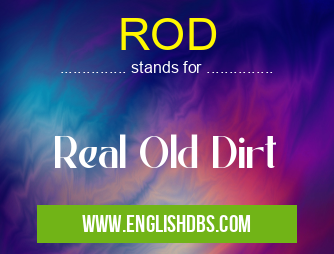
ROD mostly used in an acronym US Government in Category Governmental that means Real Old Dirt
Shorthand: ROD,
Full Form: Real Old Dirt
For more information of "Real Old Dirt", see the section below.
However, depending on your professional field, the ROD meaning can shift dramatically. While gardeners use it to describe the perfect planting medium, official agencies use the same three letters for crucial administrative processes. Understanding what does ROD stand for requires looking at both its informal, down-to-earth roots and its highly formalized professional applications.
ROD Meaning in GOVERNMENTAL
When transitioning from backyard soil talk to official public administration, the terminology becomes much more structured. If you are navigating public registries, environmental policies, or municipal offices, understanding the ROD meaning in GOVERNMENTAL sectors is essential.
In government and legal frameworks, this abbreviation typically represents two primary pillars:
- Record of Decision (ROD): Under environmental laws, such as the National Environmental Policy Act (NEPA), a Record of Decision is a formal public document. It is issued by a governmental agency to state the final decision on a project, outlining the environmental impacts, alternatives considered, and planned mitigation efforts.
- Registrar of Deeds (ROD): In local and municipal governments, this refers to the official office or officer responsible for maintaining real estate records, land titles, and property deeds.
Whether an agency is protecting the environment or securing land ownership, these governmental documents are legally binding and vital for public transparency.
Essential Questions and Answers on Real Old Dirt in "GOVERNMENTAL»USGOV"
What does ROD stand for?
In agricultural and environmental sciences, ROD stands for Real Old Dirt, a term designating highly matured, stable soil matrices or paleosols that have undergone extensive natural weathering over long periods.
What is the ROD full form and why is it important to soil scientists?
The ROD full form is Real Old Dirt, which represents a crucial resource in geobiology because these ancient geological layers preserve historical records of organic matter, atmospheric composition, and prehistoric ecosystem climates.
What is the precise ROD meaning in the context of ecological restoration?
The ROD meaning refers to deeply aged, mineral-dense soil that contains highly stable humus and resilient microbial communities capable of revitalizing severely depleted or damaged modern topsoil.
Where and how is ROD used in commercial and scientific industries?
Landscaping professionals and conservationists apply Real Old Dirt to establish robust microbial foundations in organic farming, while researchers analyze its structural composition to study climate history and soil erosion prevention.
Final Words: Acronyms often carry multiple layers of meaning, bridging the gap between casual slang and professional jargon. Whether you are talking about the rich Earth beneath your feet with Real Old Dirt, or filing official property paperwork at a municipal office, knowing what does ROD stand for helps you navigate the conversation with confidence. By distinguishing the casual ROD meaning from its official, legal counterparts, you can ensure clear and accurate communication in any setting.
ROD also stands for: |
|
| All stands for ROD |
