What does AAIMS mean in STATES
In the diverse landscape of modern education, ensuring that every student has a fair opportunity to demonstrate their knowledge is paramount. When discussing inclusive academic frameworks, the term AAIMS frequently appears. If you have ever wondered, "what does AAIMS stand for?", it is an acronym representing the Alternate Assessment based on Alternate Achievement Standards.
AAIMS meaning in States in Regional
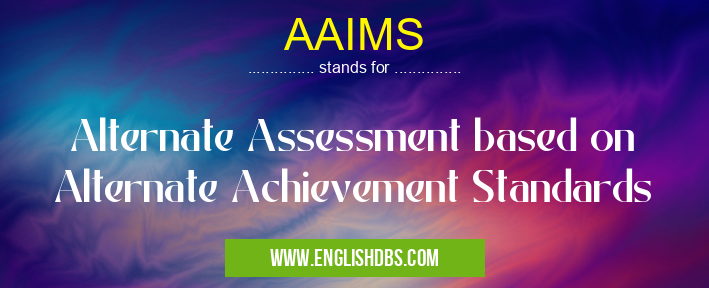
AAIMS mostly used in an acronym States in Category Regional that means Alternate Assessment based on Alternate Achievement Standards
Shorthand: AAIMS,
Full Form: Alternate Assessment based on Alternate Achievement Standards
For more information of "Alternate Assessment based on Alternate Achievement Standards", see the section below.
Essentially, the AAIMS meaning revolves around a specialized evaluation system designed for students with significant cognitive disabilities. These students may find it challenging to participate in standard state assessments, even with accommodations. By utilizing the AAIMS full form—Alternate Assessment based on Alternate Achievement Standards—educators can measure academic progress against benchmarks that are specifically tailored to a student's unique functional and cognitive needs, while still remaining aligned with the general curriculum.
AAIMS Meaning in REGIONAL
Understanding the AAIMS meaning in REGIONAL contexts requires looking at how different educational districts and state boards implement these standards. While the federal framework provides the guidelines, the specific application often varies depending on the regional educational authority and their specific curriculum goals.
In various regional settings, the implementation of AAIMS ensures that schools remain accountable for the progress of all learners, not just those taking traditional exams. Here are a few key aspects of how this assessment functions within a regional framework:
- Customized Benchmarks: Unlike standardized tests that use a "one-size-fits-all" approach, the AAIMS meaning in a regional sense implies that achievement standards are adjusted to be challenging yet attainable for the specific student population.
- Curriculum Alignment: Even though the standards are "alternate," they are still linked to the same core content areas (such as Math and Language Arts) used in the general regional curriculum.
- Data-Driven Instruction: Regional directors use the data from these assessments to allocate resources and support services where they are needed most, ensuring that no student is left behind.
When educators ask, "what does AAIMS stand for" in the context of their specific district, they are usually looking for the operational guidelines that dictate how these alternate standards are graded and reported. It is a vital tool for maintaining inclusivity and high expectations for students with diverse learning profiles.
Essential Questions and Answers on Alternate Assessment based on Alternate Achievement Standards in "REGIONAL»USSTATES"
What is the full form and meaning of AAIMS?
The acronym AAIMS stands for Alternate Assessment based on Alternate Achievement Standards, and it represents a specialized evaluation system designed for students with significant cognitive disabilities who cannot participate in general state assessments.
What does AAIMS stand for within the framework of special education?
In the context of educational policy, AAIMS stands for Alternate Assessment based on Alternate Achievement Standards, which allows educators to measure academic progress against benchmarks that are specifically tailored to a student's unique learning needs.
Where and how is AAIMS used to evaluate student performance?
State education agencies use AAIMS to fulfill federal accountability requirements by assessing the core academic knowledge of students who require the most intensive instructional supports in subjects like mathematics, language arts, and science.
How does the AAIMS process differ from standard grade-level assessments?
While standard assessments measure performance against grade-level expectations, AAIMS utilizes alternate achievement standards that are broad and simplified yet still aligned with the general state curriculum to ensure academic inclusion.
Who determines if a student should be assessed using the AAIMS criteria?
A student’s Individualized Education Program team, which includes parents and professional educators, makes the formal determination to use AAIMS based on a thorough review of the student's cognitive abilities and instructional requirements.
Why is the implementation of AAIMS important for school accountability?
AAIMS is essential because it guarantees that students with significant cognitive disabilities are not excluded from state-wide reporting, thereby holding schools accountable for the progress of every learner regardless of their disability status.
Final Words: In summary, understanding the AAIMS meaning is essential for anyone involved in special education or school administration. By recognizing the AAIMS full form as the Alternate Assessment based on Alternate Achievement Standards, we acknowledge a system that values the progress of every individual learner.
This assessment method bridges the gap between high academic expectations and the practical realities of students with significant cognitive challenges. Ultimately, the AAIMS meaning in REGIONAL education systems serves as a testament to the commitment of providing a high-quality, equitable education for every student, regardless of their starting point. Navigating these assessments with care and professional insight ensures that every child's academic journey is measured with fairness and dignity.
