What does FAIR mean in NASA
In the fast-paced worlds of manufacturing, aerospace, and engineering, precision isn’t just a goal—it is a strict requirement. When sourcing high-quality parts, organizations rely on detailed documentation to track every step of the production cycle. This is where the term FAIR comes into play. If you have ever wondered, what does FAIR stand for, the answer lies in the meticulous tracking of manufacturing steps: it stands for Fabrication, Assembly, and Inspection Record.
FAIR meaning in NASA in Governmental
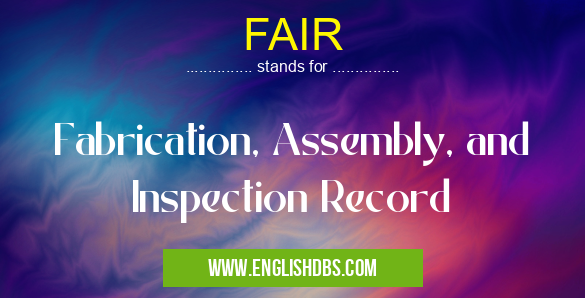
FAIR mostly used in an acronym NASA in Category Governmental that means Fabrication, Assembly, and Inspection Record
Shorthand: FAIR,
Full Form: Fabrication, Assembly, and Inspection Record
For more information of "Fabrication, Assembly, and Inspection Record", see the section below.
» Governmental » NASA
Understanding the FAIR full form is essential for quality assurance professionals and supply chain managers alike. Essentially, the FAIR meaning revolves around a comprehensive document that verifies a manufactured part meets all specified design, physical, and dimensional requirements before it is delivered to the end-user.
To break it down, this record typically contains three core phases:
- Fabrication: Detailed documentation showing how raw materials were shaped, cut, treated, or formed.
- Assembly: A step-by-step account of how individual components were joined together to create the final product.
- Inspection: The rigorous verification and testing process to ensure the final product matches the engineering drawings and quality specifications.
FAIR Meaning in GOVERNMENTAL
When we look at the FAIR meaning in GOVERNMENTAL sectors, the stakes become significantly higher. Government agencies, particularly in defense, aviation, and public infrastructure, deal with mission-critical projects where a single component failure could have catastrophic consequences. Consequently, government contractors must adhere to strict regulatory standards, making the fabrication, assembly, and inspection record a vital asset.
In this context, governmental bodies use these records to:
- Ensure Traceability: Every material source, manufacturing process, and inspector's signature is logged, providing an unbroken audit trail back to the origin.
- Maintain Regulatory Compliance: Adhering to standards such as AS9100, ISO 9001, or specific military specifications (MIL-SPEC) that are often mandated by federal contracts.
- Mitigate Risk: Verifying that military-grade equipment, aerospace parts, and public infrastructure components are structurally sound and manufactured exactly to spec.
Ultimately, the FAIR meaning in GOVERNMENTAL acquisition programs is all about accountability. It guarantees that taxpayer-funded projects are built with the highest standards of safety, durability, and reliability.
Essential Questions and Answers on Fabrication, Assembly, and Inspection Record in "GOVERNMENTAL»NASA"
What does FAIR stand for and what is its full form?
The acronym FAIR stands for Fabrication, Assembly, and Inspection Record, which is the full form used in manufacturing and quality engineering to denote a comprehensive verification document.
What is the underlying FAIR meaning in quality assurance?
The FAIR meaning refers to a structured quality control document that provides documented evidence that all manufacturing, assembly, and inspection processes have been executed in strict accordance with engineering designs and specifications.
Where and how is a Fabrication, Assembly, and Inspection Record (FAIR) used in industry?
A Fabrication, Assembly, and Inspection Record is used primarily in highly regulated sectors such as aerospace, defense, and medical device manufacturing to establish a reliable verification trail by documenting physical dimensions, material certifications, and testing results during the production cycle.
What are the primary benefits of implementing a Fabrication, Assembly, and Inspection Record in a production facility?
Implementing this record helps manufacturers minimize production errors, ensure regulatory compliance, provide customers with verified proof of product quality, and establish robust traceability for every component produced.
Final Words: In summary, grasping the FAIR meaning goes beyond simply knowing its acronym; it is about recognizing the foundation of modern quality control. Whether utilized in commercial manufacturing or analyzed for its critical FAIR meaning in GOVERNMENTAL applications, this document acts as a safeguard for quality, safety, and accountability. By providing a clear, verifiable roadmap of a product's creation, the FAIR full form—Fabrication, Assembly, and Inspection Record—remains an indispensable tool in today’s highly regulated global supply chain.
