What does E102 mean in FOOD ADDITIVES
Have you ever glanced at the ingredient list on a bright yellow package of candy, a bottle of soft drink, or a box of instant pudding and spotted a mysterious code? If you have seen the label "E102," you might wonder: what does E102 stand for? Simply put, this alphanumeric code represents a widely used synthetic food coloring known as Tartrazine.
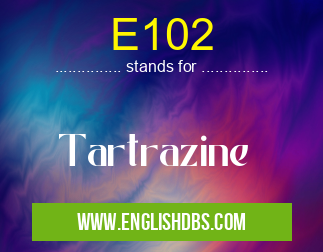
E102 meaning in Food Additives in Miscellaneous
E102 mostly used in an acronym Food Additives in Category Miscellaneous that means Tartrazine
Shorthand: E102,
Full Form: Tartrazine
For more information of "Tartrazine ", see the section below.
Understanding the E102 meaning is essential for conscious consumers who want to know exactly what goes into their food and daily-use products. In the global regulatory system, "E" numbers are codes assigned to food additives to simplify labeling across international markets. Let’s dive deeper into the E102 full form, its diverse applications, and why this specific colorant attracts so much attention in the consumer world.
E102 Meaning in MISCELLANEOUS
When exploring the E102 meaning in MISCELLANEOUS categories, we look beyond simple food manufacturing. Tartrazine is a synthetic lemon-yellow azo dye primarily derived from petroleum byproducts. Because it is highly water-soluble, cost-effective, and exceptionally stable under heat and light, it has found its way into a vast array of non-food products, making its classification truly miscellaneous.
Here is a breakdown of where you will frequently encounter E102 across different industries:
- Food and Beverage Industry: This is its most common home. You will find it in carbonated drinks, gelatin desserts, corn chips, breakfast cereals, mustards, and various baked goods to give them an appealing, vibrant yellow or green hue (when mixed with blue dyes).
- Pharmaceuticals and Supplements: Many medicinal tablets, capsules, syrups, and vitamin gummies use this dye to make pills easily identifiable and visually consistent for patients.
- Cosmetics and Personal Care: It is widely used in liquid soaps, hand sanitizers, shampoos, cosmetics, and perfumes to achieve a pleasing aesthetic look.
- Household and Industrial Products: From dishwashing liquids to crayons, pet foods, and inks, E102 provides bright coloration for non-ingestible household items.
While it is approved for use by major regulatory bodies like the European Food Safety Authority (EFSA) and the US FDA (where it is known as FD&C Yellow No. 5), it is not without controversy. Some studies suggest a potential link between synthetic colorings and increased hyperactivity in children, which is why foods containing E102 in the European Union must carry a warning label stating it "may have an adverse effect on activity and attention in children." Additionally, individuals with aspirin sensitivities may experience mild allergic reactions, such as hives or asthma, when consuming products containing this additive.
Essential Questions and Answers on Tartrazine in "MISCELLANEOUS»FOODADDTV"
What does E102 stand for and what is its meaning?
The E102 full form stands for Tartrazine, which is a synthetic lemon yellow azo dye. In the context of ingredient labeling, the E102 meaning refers to a standardized European code for this specific food coloring agent, which is used globally to give products a vibrant yellow hue.
Where and how is E102 used in everyday consumer goods?
This dye is primarily used in the food industry to color items such as carbonated beverages, confectionery, cereals, sauces, and packaged desserts. Additionally, E102 is frequently utilized in the pharmaceutical and cosmetic industries to color medications, liquid soaps, shampoos, and cosmetics.
Are there any health risks or labeling requirements associated with E102?
While regulatory bodies like the European Food Safety Authority consider it safe within prescribed limits, E102 can trigger mild allergic reactions, such as hives or asthma, in sensitive individuals. Consequently, foods containing Tartrazine in certain regions must feature a warning label indicating that it may have an adverse effect on activity and attention in children.
Final Words: In summary, demystifying the E102 meaning helps us make highly informed choices about the products we bring into our homes. Whether you recognize it by its E102 full form—Tartrazine—or its American counterpart, Yellow 5, this versatile yellow dye plays a massive role in visual marketing across food, cosmetic, and pharmaceutical sectors. By staying aware of what these codes represent, you can easily navigate ingredient labels and decide whether to welcome this vibrant additive into your daily routine or opt for natural, dye-free alternatives.
